


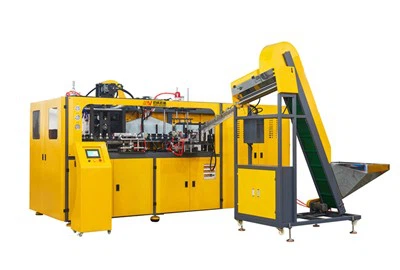
Pet Blow Molding Machine
Bottle Production Flowchart
Preform→Preform feeding→Auto blow molding machine→Bottle
The description of MW-2500B:
|
Model |
Unit |
MW-2500B |
|
|
Clamping System |
Number of cabity |
cavities |
2 |
|
Clamping unit |
KG |
45000 |
|
|
Mold stroke |
mm |
110 |
|
|
Stretching stroke |
mm |
400 |
|
|
Bottom stroke |
mm |
50 |
|
|
Cavity pitch |
mm |
114.3 |
|
|
Number of holder |
PCS |
52 |
|
|
Container |
Max.container volume |
ml |
1500 |
|
Max.container height |
mm |
330 |
|
|
Max.container diameter |
mm |
105 |
|
|
Max.preform height |
mm |
140 |
|
|
Max.neck diameter |
mm |
38 |
|
|
Theoretical |
B/H |
2000 |
|
|
Electrical System |
Heating oven qty |
PCS |
4*4 |
|
Number of lamp |
PCS |
4*8 |
|
|
Heating power |
KW |
48 |
|
|
Installed power |
KW |
50 |
|
|
Voltage |
voltage |
380V/50HZ |
|
|
Air System |
Operating pressure |
mpa |
0.7-0.9 |
|
Blowing pressure |
mpa |
2.5-3.0 |
|
|
High pressure air consumption |
L/min |
2.4/30 |
|
|
power |
KW |
30 |
|
|
Chiller System |
Temperature |
|
9-13 |
|
Pressure |
mpa |
0.4 |
|
|
Power |
HP |
3 |
|
|
Machine |
Machine dimension |
M |
3.3*1.8*2.2 |
|
Machine weight |
KG |
2500 |
|
Configuration List
|
Name |
Origin |
Brand |
|
Inductive Sensor |
Japan |
Omron |
|
Magnetic Sensor |
China |
Segula |
|
Proximity Sensor |
China |
Segula |
|
Power Switch |
France |
Schneider |
|
Breaker |
France |
Schneider |
|
Intermediary Relay 24V |
France |
Schneider |
|
AC Contactor 220V |
France |
Schneider |
|
Signal Amplification |
China |
Touchwin |
|
Touchscreen(PLC) |
JAPAN |
Mistubishi |
|
24V Power Box 24V |
Taiwan |
Delta |
|
Heating Lamp |
China |
Jieneng |
|
Motor in Preform elevator and unscramble |
China |
Taili |
|
Adjustable Voltage Module |
China |
Aoyi |
|
Temperature Regulator |
China |
Yatai |
|
Throttling Valve |
Taiwan |
Airtac |
|
Movement Valve |
Taiwan |
Airtac |
|
Stretching Cylinder |
|
|
|
Main Driving, Bottle |
China |
XinJie |
|
Clamping Cylinder |
|
|
|
stretching, Mould clamping) |
China |
XinJie |
|
Automatic type |
China |
XinJie |
|
Rail |
Taiwan |
PML |
|
Cylinder for Pushing Preform |
JAPAN |
SMC |
|
Cylinder in robot for evelating preform |
JAPAN |
SMC |
|
Cylinder in robot for preform transfer |
JAPAN |
SMC |
|
Preform Rotary Cylinder in Robot |
JAPAN |
SMC |
|
Cylinder for Robot Clip |
Taiwan |
Mindman |
|
Sealing Cylinder |
Taiwan |
Lind |


What is Pet Blow Molding Machine
A PET (Polyethylene Terephthalate) Blow Molding Machine is a specialized piece of manufacturing equipment used to create hollow plastic containers or bottles through a process known as blow molding. This process is particularly popular in the production of bottles for beverages, cosmetics, and pharmaceuticals due to the lightweight, durable, and recyclable nature of PET.
Cost-Effectiveness
PET blow molding is a relatively inexpensive manufacturing process, as it uses less material and produces less waste than other methods. This can lead to significant savings for manufacturers, especially those producing large volumes of containers.
Design Flexibility
PET blow molding can be used to create containers of all shapes and sizes, with complex features and intricate designs. This makes it a versatile manufacturing method that can be used to meet the specific needs of a wide variety of applications.
Stable Quality
Due to the unified mold and rotary bottle blowing system, Pet Blow Molding Machine can be produced on a large scale to maintain the unity and stability of product quality.
Types of PET Blow Molding Machines
Extrusion Blow Molding Machine
In extrusion blow molding (EBM), plastic is melted and extruded into a hollow tube (a parison). This parison is then captured by closing it into a cooled metal mold. Air is then blown into the parison, inflating it into the shape of a hollow bottle, container, or part. After the plastic has cooled sufficiently, the mold is opened and the part is ejected. It is designed to manufacture high-volume hollow plastic products. Products manufactured by extrusion blow molding machines are milk or water bottles, shampoo bottles, automotive air ducts, plastic buckets, and hollow industrial preform parts such as plastic buckets or other plastic containers.
Accumulative Blow Molding Machine
Accumulative blow molding machines incorporate the latest technology and innovative designs, ensuring excellent production efficiency and product quality. Accumulative blow molding machines are highly energy-efficient and energy-saving during production. The advanced heating system and insulation design can minimize energy consumption, and it has fast heating and cooling functions, which improves production efficiency. It is suitable for the production of various plastic products, such as bottles, containers, barrels, etc. It is not only suitable for common plastics such as blown polyethylene (PE) and polypropylene (PP), but also can handle special high-temperature plastics and engineering plastics.
Multi-Layer Blow Molding Machines
A multi-layer blow molding machine extrudes multiple layers of plastic film and overlays them to form a composite film. Firstly, plastic particles are heated and melted, and then a thin film is formed through an extruder. After cooling and stretching, the thin film is rolled to form a multi-layer composite film.
Full Electric Blow Molding Machine
Full electric blow molding machine using only electric and pneumatic parts. These systems lead to no oil leaking problems and save the maintenance costs of plastic manufacturers. Shortened cycle time and the reduced defective product rate are also taken into consideration. Constant cycle time control maximizes recurrence of product weight.
Understand the Process
Especially if you're beginning in the field of injection blow molding, spend time researching and learning everything possible about the process. As an example, an injection blow plastic molding machine is different from a stretch molding machine. The injection molding process is what manufacturers use to make hollow bottles and containers. With this, you can produce a high quantity of repeatable products. In comparison, the stretch blow molding process creates high-quality and high clarity bottles.
Making PET Bottles and Containers
Another factor has to do with making PET bottles and containers. For this, two types of machinery exist. First, there's a plastic molding machine for the cold preform method. Second, manufacturers use a different machine for the hot preform method.The cold method requires two machines. Although a two-step process, it's the most energy-efficient of the two. As for the hot method, you need just one machine. Again, the right source offers both from the most respected injection blow molding machine manufacturers.
Manufacturing Capacity
Buy a machine that can keep up with demand. A one-step plastic molding machine works best for small to medium capacities. The two-step method is ideal for manufacturing PET products on a large scale.

Working Principle of PET Blow Molding Machines
Preheating the PET Preform
The PET preform is heated in an oven to a temperature of around 160-180 degrees Celsius. This makes the plastic soft and pliable, so that it can be easily stretched and blown into shape.
Blowing the PET Bottle
The heated preform is transferred to a blow mold, which is a two-piece mold that forms the shape of the bottle. A blow pin is inserted into the neck of the preform, and compressed air is used to inflate the preform until it fills the mold cavity. The pressure of the air forces the plastic to stretch and conform to the shape of the mold.
Cooling and Ejecting the PET Bottle
Once the bottle has been blown to the desired shape, it is cooled with water or air. This cools the plastic and hardens it, so that it can retain its shape. The cooled bottle is then ejected from the mold.
How to Maintain PET Blow Molding Machines
Regularly Clean the Machine
Cleaning your PET blow molding machine is vital for its longevity and performance. Ensure that all the components of the machine are free from debris and other foreign substances that could negatively impact the machine's molding process. Regular cleaning with appropriate cleaning solutions would minimize the incidence of contamination and prolong the machine's operational life.
Periodically Lubricate Machine Parts
Lubricating machine parts can reduce friction between moving parts that are susceptible to wear and tear. Friction can cause the machine to malfunction and, over time, completely fail. Regular lubrication can increase the lifespan of the machine, as well as enhance its productivity and reduce maintenance costs.
Check the Condition of the Machine's Heater Blocks
PET Blow Molding Machines rely on heat to shape and mold plastic containers. Over time, the heater block's condition can deteriorate, which can lead to irregular heating and a resulting malformed container. Checking, cleaning, and replacing damaged heater blocks, therefore, becomes critical for maintaining the machine's efficacy.
Inspect the Cooling System
The cooling system is essential in the PET bottle blower/Bottle molding machine as it helps cool the mold and molded product to improve its durability and final quality. An inefficient cooling system can decrease the machine's productivity and, eventually, lead to a complete shutdown. Checking and maintaining the cooling system are crucial for preventing such occurrences.
Tighten Machine Screws
Tightening loose machine screws helps to prevent machine vibrations that could damage the machine's structural integrity. Vibrations from loose screws can also impact the final product's quality, making it desirable for PET bottle blower manufacturers to tighten the machine screws periodically.
Beverage Bottles
PET bottles are the most common type of container for carbonated soft drinks, water, and juice. They are lightweight, durable, and recyclable, making them an ideal choice for beverage packaging.
Food Containers
PET containers are also used for a variety of food products, such as yogurt, ketchup, and salad dressings. They are clear and transparent, which allows consumers to see the product inside. They are also resistant to chemicals and can withstand high temperatures, making them suitable for hot-fill applications.
Personal Care Products
PET bottles and jars are commonly used for personal care products, such as shampoo, conditioner, and lotion. They are lightweight and easy to handle, and they can be designed in a variety of shapes and sizes to accommodate different product formulations.
Pharmaceutical Bottles
PET bottles are increasingly being used for pharmaceutical packaging. They are tamper-evident and can be sterilized, making them ideal for storing and dispensing medications.
Industrial Containers
PET containers are also used for a variety of industrial applications, such as chemicals, lubricants, and cleaning products. They are strong and durable, and they can be designed to withstand harsh environments.
Frequently Asked Questions
Hot Tags: pet blow molding machine, China pet blow molding machine manufacturers, suppliers, factory, Hand Feeding Blow Molding Machine,
You Might Also Like


Send Inquiry