

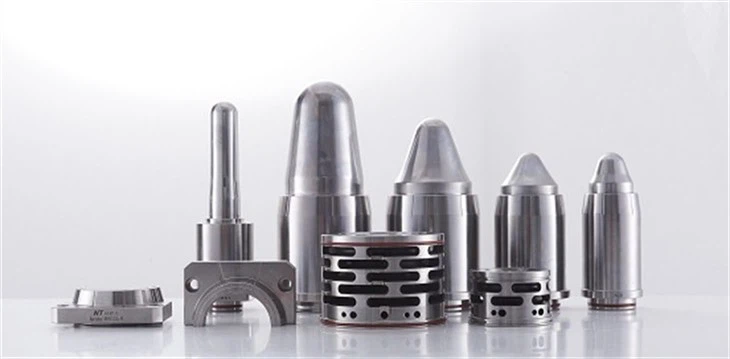
As a supplier of Preform Die, ensuring the high - quality mechanical properties of our preform dies is of utmost importance. The mechanical properties of a preform die directly impact its performance, durability, and the quality of the preforms it produces. In this blog, I will share some common methods for testing the mechanical properties of a preform die.
1. Hardness Testing
Hardness is one of the most fundamental mechanical properties of a preform die. A die with appropriate hardness can resist wear, deformation, and maintain its shape during the injection molding process. There are several methods for hardness testing, and the choice of method depends on the size, shape, and material of the die.
Rockwell Hardness Test
The Rockwell hardness test is a widely used method. It measures the depth of penetration of an indenter into the material under a specific load. A minor load is first applied to seat the indenter, followed by a major load. The difference in the depth of penetration between the minor and major loads is used to determine the hardness value. This test is relatively quick and can be performed on a variety of materials, including the steels commonly used in preform die manufacturing.

Brinell Hardness Test
The Brinell hardness test involves pressing a hard steel or carbide ball into the surface of the die under a known load for a specific period. The diameter of the indentation left on the surface is measured, and the Brinell hardness number is calculated. This test is suitable for testing materials with a relatively large grain size or for obtaining an average hardness value over a larger area.
Vickers Hardness Test
The Vickers hardness test uses a square - based pyramid indenter. A load is applied to the indenter, and the diagonal length of the resulting indentation is measured. The Vickers hardness number is then calculated. This test is more accurate for small - scale hardness measurements and can be used to test the hardness of different micro - structures within the die material.
2. Tensile Testing
Tensile testing is used to determine the strength and ductility of the preform die material. A test specimen is prepared according to relevant standards, usually in the form of a dog - bone shape. The specimen is then placed in a tensile testing machine, and a gradually increasing load is applied until the specimen breaks.
During the test, several important parameters are measured. The ultimate tensile strength (UTS) is the maximum stress the material can withstand before breaking. The yield strength is the stress at which the material begins to deform plastically. The elongation at break is a measure of the material's ductility, indicating how much it can stretch before failure.
For preform dies, high ultimate tensile strength and appropriate yield strength are crucial. A die with high UTS can withstand the high pressures and forces during the injection molding process without breaking. However, some ductility is also required to prevent sudden brittle failure.
3. Impact Testing
Impact testing is used to evaluate the toughness of the preform die material. Toughness is the ability of a material to absorb energy and deform plastically before fracturing. In the injection molding process, the die may be subjected to sudden impacts, such as when the mold closes or when the preform is ejected.
The Charpy and Izod impact tests are the most common methods. In the Charpy test, a notched specimen is supported as a simply - supported beam, and a pendulum is released to strike the specimen at the notch. The energy absorbed by the specimen during fracture is measured. The Izod test is similar, but the specimen is supported as a cantilever beam.
A preform die with high toughness can better withstand these impact loads, reducing the risk of cracking or chipping. The results of impact testing can also provide insights into the material's resistance to fatigue and its ability to perform under dynamic loading conditions.
4. Fatigue Testing
Fatigue failure is a common problem in preform dies. During the injection molding process, the die is subjected to repeated cycles of high pressure and temperature, which can lead to the initiation and propagation of cracks over time. Fatigue testing is used to simulate these cyclic loading conditions and determine the fatigue life of the die material.
In fatigue testing, a specimen is subjected to a cyclic load at a specific frequency and stress level. The number of cycles until failure is recorded. By testing specimens at different stress levels, a fatigue curve (S - N curve) can be generated, which shows the relationship between the stress amplitude and the number of cycles to failure.
For preform die design and manufacturing, understanding the fatigue properties of the material is essential. By selecting a material with good fatigue resistance and optimizing the die design to reduce stress concentrations, the fatigue life of the die can be significantly extended.
5. Compression Testing
Compression testing is used to evaluate the ability of the preform die to withstand compressive forces. In the injection molding process, the die is subjected to high compressive pressures when the molten plastic is injected into the cavity.
A compression test is similar to a tensile test, but instead of pulling the specimen, a compressive load is applied. The test measures the compressive strength of the material, which is the maximum stress the material can withstand under compression before failure.
For preform dies, high compressive strength is necessary to ensure that the die does not deform or collapse under the high pressures of the injection molding process. Compression testing can also help identify any weaknesses in the die material or design that may lead to premature failure under compressive loads.
6. Microstructural Analysis
Microstructural analysis is an important complementary method for understanding the mechanical properties of a preform die. By examining the microstructure of the die material using techniques such as optical microscopy, scanning electron microscopy (SEM), and transmission electron microscopy (TEM), we can gain insights into the grain size, phase composition, and distribution of inclusions.
A fine - grained microstructure generally results in better mechanical properties, such as higher strength and toughness. The presence of certain phases or inclusions can also affect the material's performance. For example, the presence of large inclusions may act as stress concentrators, reducing the material's fatigue resistance.
By combining microstructural analysis with the results of mechanical testing, we can better understand the relationship between the material's structure and its mechanical properties. This knowledge can be used to optimize the heat treatment process, select the appropriate alloy composition, and improve the overall quality of the preform die.
Conclusion
Testing the mechanical properties of a preform die is a comprehensive and crucial process. By using a combination of hardness testing, tensile testing, impact testing, fatigue testing, compression testing, and microstructural analysis, we can accurately evaluate the performance and quality of the die. As a Preform Die supplier, we are committed to ensuring that our dies meet the highest standards of mechanical performance.
If you are in the market for high - quality Injection Preform Mold or Hot Runner Preform Mold, and you want to ensure that the dies you purchase have excellent mechanical properties, please feel free to contact us for procurement and negotiation. We are ready to provide you with detailed product information and customized solutions to meet your specific needs.
References
- ASTM International. (20XX). Standard test methods for various mechanical properties.
- Callister, W. D., & Rethwisch, D. G. (20XX). Materials Science and Engineering: An Introduction. Wiley.
- Dieter, G. E. (20XX). Mechanical Metallurgy. McGraw - Hill.


