

As a preform die supplier, I've had the privilege of witnessing firsthand the distinct characteristics and applications of cold-forming and hot-forming preform dies. These two manufacturing processes are fundamental in producing preforms, which are used in various industries, especially in the production of plastic bottles and containers. In this blog, I'll delve into the differences between cold-forming and hot-forming preform dies, exploring their processes, advantages, limitations, and typical applications.
Cold - Forming Preform Dies
Cold-forming of preform dies is a process that takes place at or near room temperature. This method involves shaping the material without applying external heat to raise its temperature significantly. Instead, mechanical force is used to deform the material into the desired preform shape.
Process
The cold-forming process typically starts with a blank, which is a piece of material cut to a specific size. This blank is then placed in the cold-forming die. The die, which is designed with the precise shape of the preform, uses a press to apply high pressure to the blank. The pressure forces the material to flow and fill the die cavity, taking on the shape of the preform. This process can involve multiple steps, such as upsetting, extrusion, and coining, depending on the complexity of the preform design.
Advantages
One of the primary advantages of cold-forming preform dies is the high precision and surface finish they can achieve. Since the material is not heated, there is no thermal expansion or contraction, which can lead to dimensional inaccuracies. This results in preforms with tight tolerances and smooth surfaces, making them ideal for applications where precision is crucial.
Cold-forming also offers excellent material utilization. The process can be highly efficient, with minimal waste generated. This is because the material is simply reshaped rather than melted and reformed, as in some other processes. Additionally, cold-forming can enhance the mechanical properties of the material. The deformation process work-hardens the material, increasing its strength and hardness.
Limitations
However, cold-forming also has its limitations. The high pressures required for the process mean that the dies need to be extremely robust. This can lead to higher tooling costs, especially for complex preform designs. The process is also limited by the formability of the material at room temperature. Some materials may crack or fracture under the high stresses of cold-forming, making them unsuitable for this process.
Applications
Cold-forming preform dies are commonly used in the production of small, high-precision components. For example, in the electronics industry, cold-formed preforms are used to create connectors and terminals. In the automotive industry, they are used for producing parts such as bolts, nuts, and gears. If you're interested in exploring cold-formed preforms for your specific needs, you might want to check out our Wide Mouth Preform Mold, which is designed to meet high-precision requirements.
Hot - Forming Preform Dies
Hot-forming, on the other hand, involves heating the material to a high temperature before shaping it. This process takes advantage of the fact that materials become more malleable at elevated temperatures, allowing for easier deformation.
Process
The hot-forming process begins by heating the material to a specific temperature, which is typically above its recrystallization temperature. Once the material reaches the desired temperature, it is transferred to the hot-forming die. The die, which is also heated to prevent rapid cooling of the material, uses a press to shape the material into the preform. After the shaping process, the preform is cooled, which can be controlled to achieve the desired mechanical properties.
Advantages
One of the main advantages of hot-forming preform dies is the ability to form complex shapes. Since the material is more malleable at high temperatures, it can be easily deformed into intricate geometries that may be difficult or impossible to achieve with cold-forming. Hot-forming also allows for the use of a wider range of materials. Materials that are too brittle or have low formability at room temperature can often be successfully hot-formed.
Another benefit is the reduced stress on the dies. The lower forces required for hot-forming mean that the dies can have a longer lifespan, reducing the overall tooling costs over time. Additionally, hot-forming can improve the internal structure of the material, resulting in better mechanical properties such as improved ductility and toughness.
Limitations
However, hot-forming also has some drawbacks. The heating process requires additional energy, which can increase the production costs. There is also a risk of oxidation and scaling on the surface of the preform, which may require additional finishing operations. The high temperatures can also lead to dimensional variations due to thermal expansion and contraction, making it more challenging to achieve tight tolerances compared to cold-forming.
Applications
Hot-forming preform dies are commonly used in industries where complex shapes and high-strength materials are required. In the aerospace industry, hot-formed preforms are used to create components such as turbine blades and structural parts. In the construction industry, they are used for producing large, custom-shaped components. If you're looking for injection preform molds that can handle hot-forming processes, our Injection Preform Mold offers high-quality solutions.
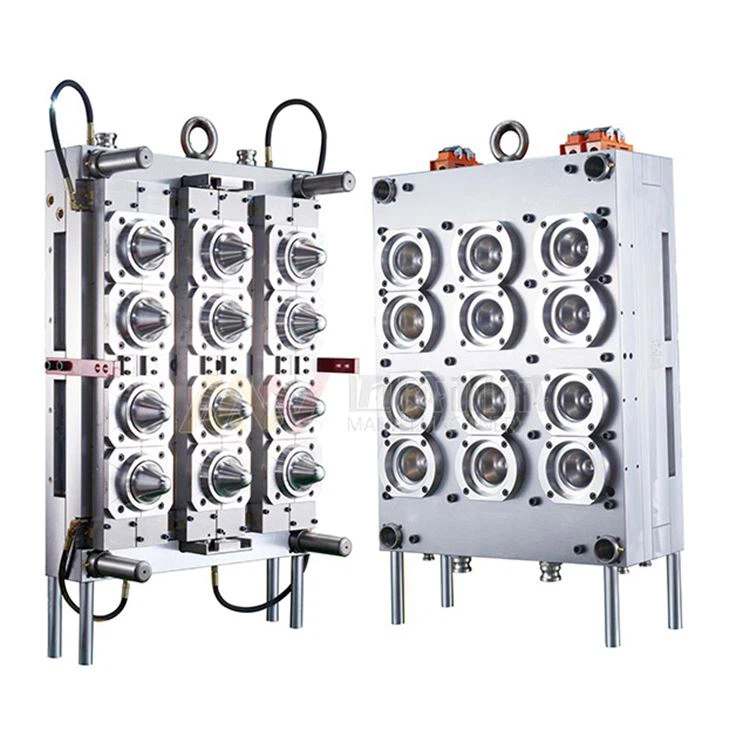

Comparison of Cold - Forming and Hot - Forming Preform Dies
When comparing cold-forming and hot-forming preform dies, several factors need to be considered.
Precision and Tolerance
Cold-forming generally offers higher precision and tighter tolerances. The absence of thermal effects allows for more accurate shaping, making it suitable for applications where dimensional accuracy is critical. Hot-forming, on the other hand, is more challenging to control in terms of dimensions due to thermal expansion and contraction, but it can still achieve acceptable tolerances for many applications.
Material Selection
Cold-forming is limited to materials with good formability at room temperature. Some high-strength alloys and brittle materials may not be suitable for cold-forming. Hot-forming, however, can handle a wider range of materials, including those that are difficult to form at room temperature.
Complexity of Shapes
Cold-forming is better suited for simple to moderately complex shapes. The high pressures required for cold-forming can make it difficult to form very intricate geometries. Hot-forming, on the other hand, excels at forming complex shapes due to the increased malleability of the material at high temperatures.
Production Costs
Cold-forming may have higher initial tooling costs due to the need for robust dies, but it can be more cost-effective for high-volume production due to its high material utilization and efficiency. Hot-forming may have lower tooling costs in the long run due to the reduced stress on the dies, but the additional energy required for heating can increase the production costs, especially for small to medium production volumes.
Conclusion
In conclusion, both cold-forming and hot-forming preform dies have their own unique advantages and limitations. The choice between the two depends on various factors, including the desired shape complexity, precision requirements, material selection, and production volume. As a preform die supplier, we understand the importance of choosing the right process for your specific needs. Whether you need a Wide Mouth Preform Mold for high-precision cold-forming or an Injection Preform Mold for hot-forming complex shapes, we have the expertise and solutions to meet your requirements.
If you're interested in learning more about our preform dies or have specific requirements for your production, please don't hesitate to contact us for a detailed discussion. We're here to help you make the best choice for your manufacturing needs.
References
- Kalpakjian, S., & Schmid, S. R. (2008). Manufacturing Engineering and Technology. Pearson Prentice Hall.
- Dieter, G. E. (1986). Mechanical Metallurgy. McGraw - Hill.
- Groover, M. P. (2010). Fundamentals of Modern Manufacturing: Materials, Processes, and Systems. Wiley.


