

Hey there! As a preform die supplier, I've been in the business long enough to know that heat treatment is a super crucial part of making top - notch preform dies. In this blog, I'm gonna share with you the different heat treatment methods for preform dies.
First off, let's understand why heat treatment matters. Preform dies need to be tough, wear - resistant, and have good dimensional stability. Heat treatment helps us achieve these properties, making the dies last longer and perform better.
Annealing
Annealing is like giving the preform die a good relaxation session. It's a heat treatment process where the die is heated to a specific temperature and then cooled slowly. This helps to relieve internal stresses that build up during manufacturing processes like machining or forging.
There are different types of annealing. Full annealing involves heating the die to a temperature above its critical range and then cooling it very slowly in the furnace. This results in a soft, ductile structure, which is great for further machining operations. For example, if we're going to do some precision milling on the preform die, a full - annealed die will be easier to work with.
Another type is stress - relief annealing. This is done at a lower temperature compared to full annealing. The main goal here is to reduce internal stresses without significantly changing the hardness of the die. After a die has been welded or undergone some heavy machining, stress - relief annealing can prevent cracking and distortion during subsequent use.
Normalizing
Normalizing is kind of similar to annealing, but with a faster cooling rate. We heat the preform die to a temperature above its critical range and then let it cool in the air. This results in a more uniform grain structure compared to the as - cast or as - forged state.
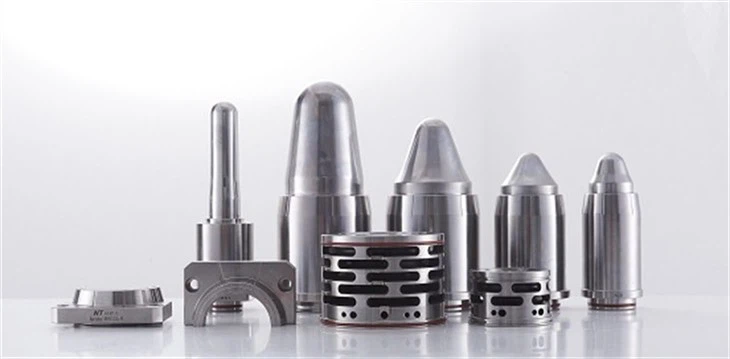
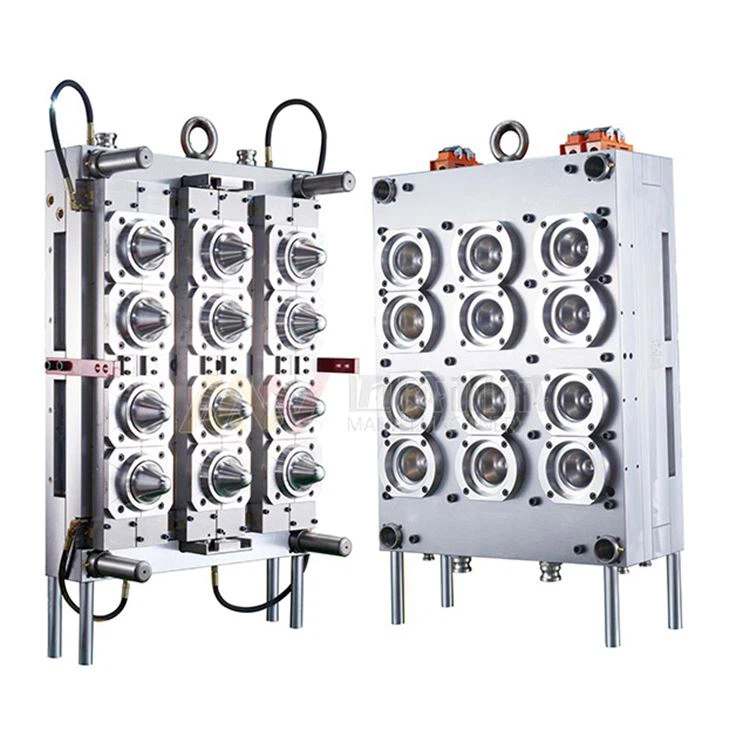
The advantage of normalizing is that it improves the mechanical properties of the die. It makes the die stronger and more ductile. A normalized preform die can withstand higher loads and impacts during the injection molding process. For instance, when the molten plastic is injected into the die at high pressure, a normalized die is less likely to deform.
Hardening
Hardening is all about making the preform die super tough. We heat the die to a high temperature within its critical range and then quench it rapidly. Quenching can be done in different media like oil, water, or a polymer solution.
Water quenching is the fastest, but it also has a higher risk of cracking. Oil quenching is a bit slower, which reduces the risk of cracking but still provides a good level of hardness. Polymer quenching is a more modern option that offers a balance between cooling speed and cracking risk.
After hardening, the die becomes very hard but also brittle. That's why we usually follow up with tempering.
Tempering
Tempering is the process of heating the hardened die to a temperature below its critical range and then cooling it at a controlled rate. This helps to reduce the brittleness of the hardened die while still maintaining a good level of hardness.
There are different tempering temperatures depending on the desired properties. Low - temperature tempering (around 150 - 250°C) is used when we want to relieve internal stresses and improve the toughness slightly without sacrificing too much hardness. High - temperature tempering (around 500 - 650°C) is used when we need a more ductile die with lower hardness.
For example, if the preform die is going to be used in a high - volume production environment where it will experience a lot of wear, a low - temperature tempered die might be the best choice. On the other hand, if the die needs to withstand some shock loading, a high - temperature tempered die would be more suitable.
Case Hardening
Case hardening is a method where we only harden the surface of the preform die while keeping the core soft and tough. This is useful when we want the die to have a hard, wear - resistant surface and a tough interior to absorb shocks.
One common case - hardening method is carburizing. We heat the die in a carbon - rich environment, allowing carbon to diffuse into the surface. After carburizing, the die is quenched and tempered. This results in a hard outer layer with a high carbon content and a tough core.
Another method is nitriding. In nitriding, we introduce nitrogen into the surface of the die. Nitrided dies have excellent wear resistance, corrosion resistance, and low friction coefficients. A nitrided preform die can produce high - quality preforms with a smooth surface finish.
Now, if you're in the market for high - quality preform dies, we've got you covered. We use these advanced heat treatment methods to ensure that our dies meet the highest standards. Whether you need an Injection Preform Mold or a Hot Runner Preform Mold, we can provide you with a die that's built to last. And if you're looking for a reliable Injection Preform Mold factory, you're in the right place.
If you're interested in our preform dies, don't hesitate to reach out. We're more than happy to discuss your specific requirements and provide you with a customized solution. Let's work together to take your injection molding business to the next level.
References
- Metals Handbook: Heat Treating, ASM International
- Fundamentals of Heat Treatment of Steels, ASM International


