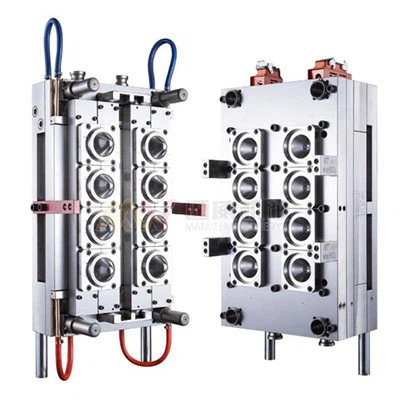
As a preform die supplier, I've had the privilege of witnessing the intricate dance of materials within preform dies during the forming process. It's a fascinating world where science and engineering come together to create the building blocks of countless plastic products. In this blog post, I'll share some insights into the material flow characteristics in a preform die during the forming process, drawing from my experiences in the industry.
The Basics of Preform Die Forming
Before diving into the material flow characteristics, let's quickly go over the basics of preform die forming. A preform is a plastic tube-like structure that is later blown into a final product, such as a bottle or a container. The preform is created by injecting molten plastic into a preform die, which is a specialized mold designed to shape the plastic into the desired preform geometry.
The forming process typically involves several stages, including filling, packing, and cooling. During the filling stage, the molten plastic is injected into the preform die cavity at high pressure and speed. The plastic then flows through the runner system and into the cavity, filling it up and taking on the shape of the die. Once the cavity is filled, the packing stage begins, where additional plastic is injected to compensate for shrinkage and ensure a consistent wall thickness. Finally, the cooling stage takes place, where the preform is cooled and solidified before being ejected from the die.
Material Flow Characteristics
The material flow characteristics in a preform die are crucial for achieving high-quality preforms with consistent dimensions and properties. Here are some of the key factors that influence the material flow during the forming process:
Viscosity
Viscosity is a measure of a fluid's resistance to flow. In the case of molten plastic, viscosity plays a significant role in determining how easily it can flow through the runner system and into the preform die cavity. Higher viscosity plastics require more pressure to flow, which can lead to issues such as incomplete filling, weld lines, and excessive stress in the preform. On the other hand, lower viscosity plastics can flow more easily, but they may also be more prone to flashing and other defects.
As a preform die supplier, we work closely with our customers to select the right plastic resin for their application based on its viscosity and other properties. We also optimize the design of the runner system and the preform die to ensure that the plastic can flow smoothly and evenly throughout the cavity.
Temperature
Temperature is another critical factor that affects the material flow in a preform die. The temperature of the molten plastic must be carefully controlled to ensure that it has the right viscosity for optimal flow. If the temperature is too low, the plastic may become too viscous and difficult to flow, while if the temperature is too high, the plastic may degrade or warp.
In addition to the plastic temperature, the temperature of the preform die itself also plays a role in the material flow. The die must be heated to a specific temperature to ensure that the plastic can flow freely and take on the shape of the cavity. The cooling system of the die must also be carefully designed to ensure that the preform cools evenly and quickly, preventing defects such as warping and shrinkage.
Pressure
Pressure is used to force the molten plastic into the preform die cavity and ensure that it fills the cavity completely. The pressure required for filling depends on several factors, including the viscosity of the plastic, the size and shape of the preform, and the design of the runner system.
During the packing stage, additional pressure is applied to the plastic to compensate for shrinkage and ensure a consistent wall thickness. The packing pressure must be carefully controlled to avoid over-packing, which can lead to excessive stress in the preform and other defects.
Shear Rate
Shear rate is a measure of the rate at which the molten plastic is deformed as it flows through the runner system and into the preform die cavity. High shear rates can cause the plastic to heat up and degrade, leading to issues such as discoloration, brittleness, and reduced mechanical properties.
To minimize the shear rate, we design the runner system and the preform die with smooth surfaces and gradual transitions. We also optimize the injection speed and pressure to ensure that the plastic flows smoothly and evenly through the cavity, reducing the risk of shear-induced defects.


Design Considerations for Preform Die
Based on the material flow characteristics described above, there are several design considerations that we take into account when designing a preform die. Here are some of the key factors:
Runner System Design
The runner system is the network of channels that connects the injection molding machine to the preform die cavity. The design of the runner system has a significant impact on the material flow and the quality of the preform.
We use computer-aided design (CAD) software to optimize the runner system design, taking into account factors such as the viscosity of the plastic, the size and shape of the preform, and the injection speed and pressure. We also use simulations to analyze the material flow and identify potential issues, such as air traps and weld lines.
Cavity Design
The cavity is the part of the preform die that shapes the plastic into the desired preform geometry. The design of the cavity must be carefully optimized to ensure that the plastic can flow smoothly and evenly throughout the cavity, filling it up completely and taking on the shape of the die.
We use advanced machining techniques to create precise and accurate cavities, with smooth surfaces and sharp edges. We also pay close attention to the draft angle of the cavity, which is the angle at which the walls of the cavity are tapered to facilitate the ejection of the preform.
Cooling System Design
The cooling system is responsible for removing heat from the preform and the preform die, allowing the plastic to solidify and the preform to be ejected from the die. The design of the cooling system has a significant impact on the cycle time, the quality of the preform, and the lifespan of the die.
We use advanced cooling technologies, such as conformal cooling channels, to ensure that the preform cools evenly and quickly, reducing the risk of warping and shrinkage. We also optimize the cooling system design to minimize the energy consumption and the maintenance requirements of the die.
Conclusion
In conclusion, the material flow characteristics in a preform die during the forming process are complex and influenced by several factors, including viscosity, temperature, pressure, and shear rate. As a preform die supplier, we understand the importance of these factors and take them into account when designing and manufacturing our preform dies.
By using advanced design and manufacturing techniques, we are able to create preform dies that optimize the material flow and produce high-quality preforms with consistent dimensions and properties. Whether you're looking for a Wide Mouth Preform Mold, a Jar Preform Mold, or a Hot Runner Preform Mold, we have the expertise and experience to provide you with the right solution for your application.
If you're interested in learning more about our preform die products and services, or if you have any questions or inquiries, please don't hesitate to contact us. We look forward to hearing from you and working with you to achieve your goals.
References
- Beaumont, J. P., Berges, J. A., & Bhattacharya, S. (2011). Injection Mold Design Handbook. Elsevier.
- Rosato, D. V., Rosato, D. V., & Krousgrill, C. M. (2000). Injection Molding Handbook. Kluwer Academic Publishers.
- Tadmor, Z., & Gogos, C. G. (2006). Principles of Polymer Processing. Wiley-Interscience.