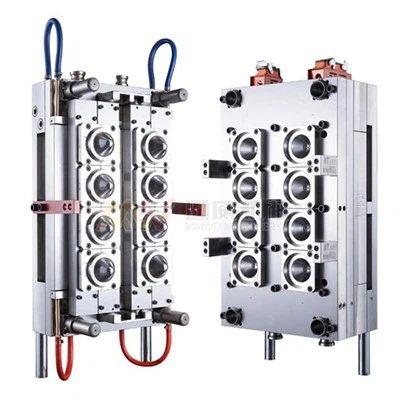
Elasticity is a vital concept in materials science, especially when dealing with products like oil bottle preforms. As a supplier of Oil Bottle Preforms, understanding the elasticity of these preforms is crucial for both the manufacturing process and the final product's quality. In this blog, we'll delve into what elasticity means in the context of oil bottle preforms, why it matters, and how it impacts various aspects of the preform and the subsequent bottle production.
What is Elasticity?
Elasticity refers to the ability of a material to deform under stress and return to its original shape when the stress is removed. In the case of an oil bottle preform, which is typically made from PET (Polyethylene Terephthalate), this property is measured in terms of how much the preform can stretch during the blow - molding process and still return to a stable form to hold the oil effectively.
The elasticity of an oil bottle preform is governed by several factors. The molecular structure of PET plays a significant role. PET is a semi - crystalline thermoplastic. The degree of crystallinity affects the preform's elasticity. A higher degree of crystallinity can make the preform more rigid and less elastic, while a lower degree allows for more flexibility during deformation.
The processing conditions during the preform manufacturing also impact elasticity. For example, the temperature at which the PET resin is melted and molded into the preform can change the molecular orientation within the material. If the temperature is not carefully controlled, it can lead to uneven elastic properties across the preform.
Importance of Elasticity in Oil Bottle Preforms
Blow - Molding Process
The blow - molding process is used to transform the preform into the final oil bottle. During this process, the preform is heated and then inflated with air or another gas. Elasticity is essential here because it allows the preform to expand smoothly and uniformly without cracking or breaking. If the preform is not elastic enough, it may rupture during the blow - molding, leading to a high rate of defective products. On the other hand, if it is too elastic, the bottle may not hold its shape properly, resulting in issues like excessive stretching in certain areas, which can affect the bottle's aesthetic and structural integrity.
Product Functionality
Once the oil bottle is formed, its elasticity influences its functionality. An oil bottle needs to be able to withstand external pressure, such as when it is stacked on shelves or during transportation. A preform with appropriate elasticity will result in a bottle that can flex slightly under pressure without breaking, protecting the oil inside. Additionally, the elasticity can also affect the bottle's ability to reseal properly. If the bottle is not elastic enough, the cap may not form a tight seal, leading to leakage over time.
Measuring the Elasticity of Oil Bottle Preforms
There are several methods to measure the elasticity of oil bottle preforms. One common approach is the tensile test. In a tensile test, a preform sample is clamped at both ends and gradually pulled until it breaks. The force applied and the amount of elongation are measured throughout the process. The stress - strain curve obtained from this test provides valuable information about the preform's elasticity. The slope of the initial linear part of the curve, known as the Young's modulus, represents the material's stiffness or the inverse of its elasticity. A lower Young's modulus indicates a more elastic material.
Another method is the flexural test. This test measures the preform's ability to bend under a load. The preform is placed on two supports, and a load is applied at the center. The deflection of the preform and the force required to cause the deflection are recorded. This test helps in understanding how the preform will behave when it is subjected to bending forces during handling and use.
Impact of Elasticity on Different Shapes and Sizes of Oil Bottle Preforms
The shape and size of an oil bottle preform can also have an impact on its elasticity. For example, preforms with a more complex shape, such as those with multiple curves or irregular surfaces, may have different elastic properties compared to simple cylindrical preforms. The distribution of stress during the blow - molding process is more uneven in complex - shaped preforms, which can lead to variations in elasticity across the preform.
In terms of size, larger preforms may require different elastic properties than smaller ones. A larger preform needs to stretch more during the blow - molding process to form a larger bottle. Therefore, it may need to have a higher degree of elasticity to ensure a smooth and uniform expansion. For instance, 5 Gallon Water Bottle Preform and 3 Gallon Water Bottle Preform have specific elasticity requirements based on their size. Similarly, our Oil Bottle Preform comes in various sizes, each with its own optimal elasticity range.
Controlling the Elasticity of Oil Bottle Preforms
As a supplier, we have several ways to control the elasticity of our oil bottle preforms. First, we carefully select the PET resin. Different types of PET resins have different inherent elastic properties. We work with resin suppliers to choose the resin that best suits the specific requirements of our preforms.
The manufacturing process also allows us to fine - tune the elasticity. We control the temperature, pressure, and cooling rates during the preform molding. For example, by adjusting the cooling rate, we can influence the degree of crystallinity in the preform, which in turn affects its elasticity. A slower cooling rate generally results in a higher degree of crystallinity and a more rigid preform, while a faster cooling rate can produce a more elastic preform.
Conclusion
The elasticity of an oil bottle preform is a complex but essential property that affects every stage of the production process, from blow - molding to the final functionality of the oil bottle. As a supplier, we are committed to understanding and controlling this property to ensure that our Oil Bottle Preform meets the highest quality standards.


If you are in the market for high - quality oil bottle preforms and want to discuss the specific elasticity requirements for your products, we invite you to contact us for a procurement discussion. We have the expertise and experience to provide you with the best solutions for your oil bottle preform needs.
References
- "Plastics Engineering Handbook of the Society of Plastics Engineers", edited by Charles A. Harper, Wiley - Interscience.
- "PET Packaging: Technology, Processing, Applications, and Regulations" by R. Shyam Sundar and S. Senthil Kumar.
- ASTM International standards related to the testing of plastics, such as ASTM D638 for tensile testing and ASTM D790 for flexural testing.