

What is the production capacity of a preform mould? Well, as a preform mould supplier, I've got a lot to say on this topic.
Let's start from the basics. A preform mould is a crucial tool in the manufacturing of plastic preforms, which are then used to make all sorts of plastic containers like bottles for drinks, cosmetics, and more. The production capacity of a preform mould refers to how many preforms it can produce within a specific period, usually an hour or a day.
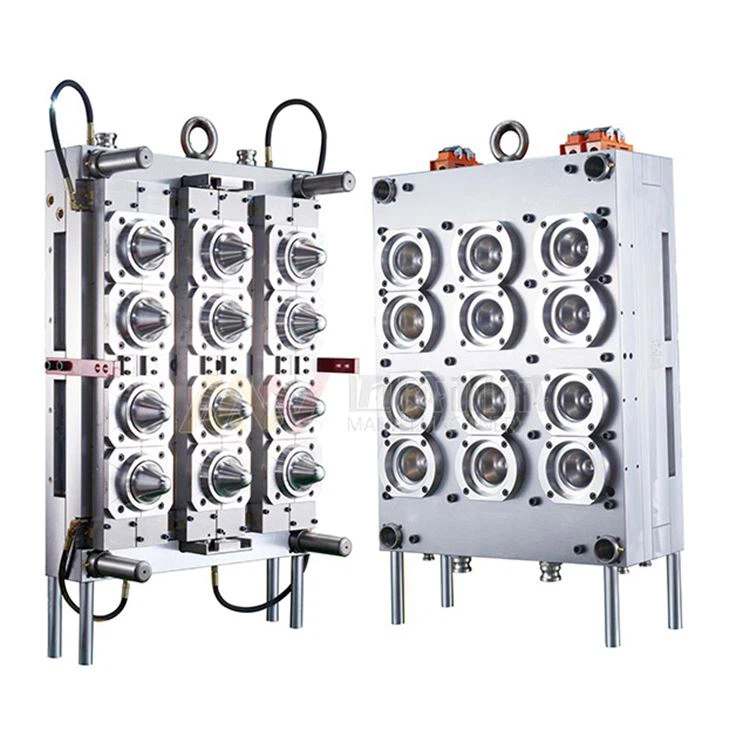
There are several factors that can influence the production capacity of a preform mould. One of the most significant factors is the number of cavities in the mould. A cavity is basically a space in the mould where the plastic material is injected to form a preform. The more cavities a mould has, the more preforms it can produce at the same time. For example, a mould with 16 cavities can produce 16 preforms in one injection cycle, while a 32 - cavity mould can double that output. So, if you're looking for high - volume production, a multi - cavity mould is definitely the way to go.
The design of the mould also plays a big role. A well - designed preform mould will have efficient cooling channels. Cooling is a critical step in the preform manufacturing process because it determines how quickly the plastic solidifies and the preform can be ejected from the mould. If the cooling is fast and uniform, the cycle time (the time it takes to complete one injection, cooling, and ejection process) will be shorter. And a shorter cycle time means more preforms can be produced in an hour.
The type of plastic material used is another factor. Different plastics have different melting points, flow properties, and cooling rates. For instance, some plastics might flow more easily into the cavities of the mould, which can speed up the injection process. On the other hand, plastics with a higher melting point might require more energy to melt and longer cooling times. So, understanding the characteristics of the plastic you're using and choosing a mould that's compatible with it is essential for maximizing production capacity.
Now, let's talk about the different types of preform moulds. There are Injection Preform Mold and Hot Runner Preform Mold. Injection preform molds are quite common. They work by injecting molten plastic into the cavities of the mould under high pressure. These molds are relatively simple in design and can be used for a wide range of plastic materials.
Hot runner preform molds, on the other hand, have a built - in system that keeps the plastic in a molten state as it travels from the injection unit to the cavities. This eliminates the need for a cold runner system, which can save a lot of plastic material and reduce cycle times. With a hot runner system, the plastic can be injected more quickly and evenly into the cavities, leading to higher production capacity.
As a preform mould supplier, I've seen many customers come to me with different production requirements. Some small - scale manufacturers might only need a mould with a few cavities to produce a limited number of preforms per day. They might be making specialty products or testing the market with a new design. For them, a simple Injection Preform Mold with a lower production capacity might be sufficient.
On the other hand, large - scale manufacturers who need to produce thousands or even millions of preforms every day will require high - cavity, high - performance moulds. They often invest in hot runner preform molds because of their ability to produce preforms at a much faster rate.
To give you an idea of the production capacity numbers, a small - scale 4 - cavity injection preform mould might be able to produce around 200 - 300 preforms per hour. A medium - sized 16 - cavity mould can produce anywhere from 1200 - 1600 preforms per hour. And a large - scale 96 - cavity hot runner preform mould can crank out 7000 - 9000 preforms per hour or even more, depending on the cycle time and other factors.
But it's not just about the raw numbers. Maintaining the quality of the preforms is also crucial. A high - production - capacity mould won't be much use if it produces defective preforms. That's why we, as preform mould suppliers, pay a lot of attention to the precision of the mould design, the quality of the materials used, and the manufacturing process.
We use advanced machining techniques and high - quality steel to ensure that the moulds are durable and can produce consistent, high - quality preforms over a long period. We also offer after - sales service, including maintenance and repair, to make sure that our customers' moulds are always in top - notch condition.
If you're in the market for a preform mould, whether you're a small - scale startup or a large - scale manufacturer, it's important to consider your production requirements carefully. Think about how many preforms you need to produce, what type of plastic you'll be using, and your budget.
If you have any questions or want to discuss your specific needs, don't hesitate to get in touch. We're here to help you find the right preform mould that suits your production capacity requirements and budget. Whether you're looking for an Injection Preform Mold, a Hot Runner Preform Mold, or something else, we've got the expertise and experience to guide you through the process.
References:
- Plastic Mould Manufacturing Handbook
- Research on Injection Molding Process Optimization


