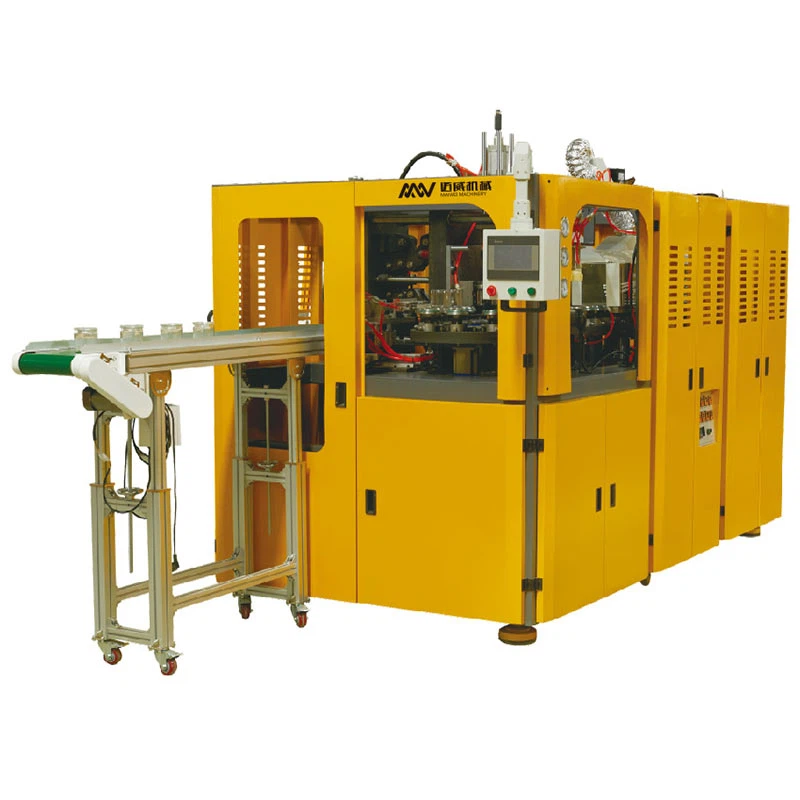
Plastic Bottle Blow Molding Machine

Plastic Bottle Blow Molding Machine

A Plastic Bottle Blow Molding Machine is a specialized piece of manufacturing equipment used to produce hollow plastic bottles from thermoplastic materials.
Send Inquiry
Product Introduction


Technical Parameters


Model

Unit

MW-1500JAR

Clamping System

Number of cabity

cavities

2

Clamping unit

KG

36000

Mold stroke

mm

120

Stretching stroke

mm

360

Bottom stroke

mm

50

Cavity pitch

mm

114.3

Number of holder

PCS

48

Container

Max.container volume

ml

1800

Max.container height

mm

320

Max.container diameter

mm

130

Max.preform height

mm

120

Max.neck diameter

mm

110

Theoretical

B/H

1400

Electrical System

Heating oven qty

PCS

4*4

Number of lamp

PCS

4*8

Heating power

KW

48

Installed power

KW

50

Voltage

voltage

380V/50HZ

System

Operating pressure

mpa

0.7-0.9

Blowing pressure

mpa

3.0

High pressure air consumption

L/min

2.4/30

power

KW

30

Chiller System

Temperature


10-15

Pressure

mpa

0.4

Power

HP

5

Machine

Machine dimension

M

3.3*1.8*2.0

Machine weight

KG

3000


Configuration List

Name

Origin

Brand

Inductive Sensor

Japan

Omron

Magnetic Sensor

China

Segula

Proximity Sensor

China

Segula

Power Switch

France

Schneider

Breaker

France

Schneider

Intermediary Relay 24V

France

Schneider

AC Contactor 220V

France

Schneider

Signal Amplification

China

Touchwin

Touchscreen(PLC)

JAPAN

Mistubishi

24V Power Box 24V

Taiwan

Delta

Heating Lamp

China

Jieneng

Motor in Preform elevator and unscramble

China

Taili

Adjustable Voltage Module

China

Aoyi

Temperature Regulator

China

Yatai

Throttling Valve

Taiwan

Airtac

Movement Valve

Taiwan

Airtac

Stretching Cylinder


Main Driving, Bottle

China

XinJie

Clamping Cylinder


stretching, Mould clamping)

China

XinJie

Automatic type

China

XinJie

Rail

Taiwan

PML

Cylinder for Pushing Preform

JAPAN

SMC

Cylinder in robot for evelating preform

JAPAN

SMC

Cylinder in robot for preform transfer

JAPAN

SMC

Preform Rotary Cylinder in Robot

JAPAN

SMC

Cylinder for Robot Clip

Taiwan

Mindman

Sealing Cylinder

Taiwan

Lind


What is Plastic Bottle Blow Molding Machine


A Plastic Bottle Blow Molding Machine is a specialized piece of manufacturing equipment used to produce hollow plastic bottles from thermoplastic materials. This process, known as blow molding, involves heating a plastic tube (preform) until it becomes pliable, then inflating it with compressed air inside a mold until it takes the mold's shape. Once the plastic cools and hardens, the mold opens, and the newly formed bottle is ejected.


Features of Plastic Bottle Blow Molding Machine
 
1

Cost-Efficiency
Plastic Bottle Blow Molding Machine is a cost-effective manufacturing process, particularly for high-volume production. It allows for the efficient use of materials, minimizing waste, and reducing production costs.


2

Versatility
Plastic Bottle Blow Molding Machine can produce a wide range of products with varying shapes, sizes, and complexities. This versatility makes them suitable for industries such as food and beverage, pharmaceuticals, cosmetics, and automotive.


3

Lightweight Products
Blow molding can create lightweight containers and parts, which is essential for industries where weight is a critical factor, such as transportation and packaging. Lightweight materials reduce shipping costs and fuel consumption.


4

Customization
Manufacturers can easily customize blow-molded products by adjusting the mold design. This flexibility allows for branding and design variations without significant tooling costs.


5

Speed and Efficiency
Blow molding is a high-speed process, capable of producing a large number of products in a relatively short time. This efficiency is valuable for meeting tight production schedules and market demands.


6

Material Options
Blow molding supports a variety of materials, including various types of plastics (HDPE, LDPE, PP, PET, etc.) and even glass. This choice of materials enables manufacturers to select the best-suited material for their specific applications.


7

Durability and Strength
Plastic Bottle Blow Molding Machine can be designed to meet specific strength and durability requirements, making them suitable for applications where robustness is essential, such as automotive components.


Parts of Plastic Bottle Blow Molding Machine
塑料瓶吹塑机
塑料瓶吹塑机
塑料瓶吹塑机
塑料瓶吹塑机

Extruder
The extruder melts and pushes the plastic resin through a die to form a continuous tube called a parison. This component is essential in converting raw plastic material into a workable form.


Die Head
The die head shapes the parison. It ensures the plastic tube has the desired thickness and diameter before it enters the mold.


Parison
The parison is a hollow tube of molten plastic created by the extruder and die head. It is inflated inside the mold to form the bottle shape.


Blow Pin
The blow pin injects compressed air into the parison, inflating it to conform to the mold's shape. It is critical for forming the internal dimensions of the bottle.


Mold
The mold is a split metal cavity that shapes the outside of the bottle. When closed, the mold captures the parison and allows it to be blown into shape.


Clamping Unit
The clamping unit holds the mold tightly shut during the blowing process. This unit ensures that the mold stays closed and the bottle maintains its shape during formation.


Cooling System
The cooling system rapidly cools the blown plastic, solidifying it into its final shape. This system is essential for achieving precise dimensions and ensuring the bottle's durability.


Trimmer
The trimmer removes excess plastic, such as the flash from the molded part, ensuring a smooth finish on the bottle.


Take-Out Robot
The take-out robot removes the finished bottle from the mold and transfers it to the next stage of production or packaging. This component increases efficiency and reduces manual handling.


Control System
The control system oversees the entire blow molding process, regulating temperature, pressure, and timing to ensure consistent bottle quality. It is usually computer-based for precision and ease of use.


How to Choose Plastic Bottle Blow Molding Machine

Programme Customized

If you have exact requirements about the size, capacity, shape, weight, average output, etc of product that you produced, you can offer this information to the supplier and they can provide economic efficiency blow molding machine selection plan. This is a pretty good choice. You'd better have a certain relevant knowledge reserve before selecting a machine. It's convenient to make a rational judgment according to your actual situation.

Produce Capacity

Estimate produce capacity requires that you need per month. Making the cross-check with suppler if it will meet the requirement. We suggest you leave 25% extra capacity.

8d5abdcda690b2ed73dec005e8336622塑料瓶吹塑机3cbc4472-eb22-4ed3-bfac-3b4ebe81bf3f

Machine Automation

Machine automation can realize by PLC control and wired relay logic. PLC control with broadly available options. This can range from customized microprocessor controllers to established control systems at the industrial level.

Auxiliary Machinery

Be attention! Auxiliary machinery is one of the main factors when we should consider blow molding machine selection. You should select auxiliary machinery according to the supplier's advice. For example, the air compressor, grinder, cooling system, and so on.


Frequently Asked Questions


Q: What is a Plastic Bottle Blow Molding Machine?

A: A Plastic Bottle Blow Molding Machine is a specialized machine used to create hollow plastic containers, such as bottles, by inflating a preformed plastic tube (called a parison) inside a mold. The machine typically uses materials like PET, HDPE, or PVC to produce various types of bottles used in industries such as beverages, pharmaceuticals, and personal care products.

Q: How does the extrusion process work in a blow molding machine?

A: In a blow molding machine, the extrusion process begins by feeding plastic resin into an extruder, where it is heated to a molten state. The extruder is equipped with a rotating screw that pushes the molten plastic through a die head, forming a hollow tube known as a parison. The parison is extruded vertically downward between the open halves of a mold. Once the desired length of the parison is achieved, the mold closes around it, and the parison is pinched at the bottom, sealing it. The next step involves blowing compressed air into the parison through a blow pin, which inflates the tube until it conforms to the shape of the mold cavity. After cooling and solidification, the mold opens, and the formed bottle is ejected. This extrusion process is continuous, making it ideal for producing large quantities of bottles.

Q: What are the different types of blow molding machines?

A: There are three primary types of blow molding machines: Extrusion Blow Molding (EBM), Injection Blow Molding (IBM), and Stretch Blow Molding (SBM).

Q: What materials are commonly used in blow molding?

A: Common materials used in blow molding include PET (Polyethylene Terephthalate), HDPE (High-Density Polyethylene), LDPE (Low-Density Polyethylene), PVC (Polyvinyl Chloride), and PP (Polypropylene).

Q: How does the cooling system function in a blow molding machine?

A: The cooling system in a blow molding machine is vital for solidifying the plastic bottle after it has been formed inside the mold. Once the parison has been inflated and shaped within the mold, the plastic is still in a molten state and must be cooled rapidly to maintain the desired shape and ensure dimensional stability. Cooling is typically achieved through a combination of air and water. The mold itself is often equipped with channels through which cold water circulates, absorbing heat from the plastic. Additionally, air is sometimes blown onto the exterior of the bottle to accelerate cooling. Efficient cooling is crucial as it directly affects the cycle time and the quality of the final product. If the cooling process is too slow, it can lead to deformation, while too rapid cooling may cause internal stresses within the plastic.

Q: What role does the mold play in a blow molding machine?

A: The mold in a blow molding machine plays a crucial role in determining the shape, size, and surface texture of the final plastic bottle. It is a split cavity tool that captures the parison when the machine closes around it. The mold is designed with precision to match the desired bottle's exact specifications, including any details like threads for caps, logos, or specific textures. When the parison is inflated inside the mold, it expands to take the mold's shape, ensuring that the bottle conforms precisely to the design. The quality of the mold is paramount because any imperfections or wear in the mold can result in defects in the bottle. Additionally, molds are usually made from high-strength materials like steel or aluminum to withstand the high pressures and temperatures involved in the blow molding process and to ensure a long production life.

Q: What is a parison, and why is it important?

A: A parison is a hollow tube of molten plastic formed during the extrusion or injection process in blow molding. It is a precursor to the final bottle shape and is central to the blow molding process. The parison's quality, size, and uniformity are critical because they directly affect the quality of the final product. If the parison is too thin or uneven, it can result in weak spots or inconsistencies in the bottle, potentially leading to defects such as blowouts or uneven wall thickness. The parison is also where the initial stages of the bottle's shape and structure begin to form. For example, in extrusion blow molding, the parison's length and diameter are carefully controlled to ensure it fits perfectly within the mold and can be inflated to the desired dimensions without excess material waste.

Q: How is air pressure used in the blow molding process?

A: Air pressure is a critical component in the blow molding process. Once the parison is enclosed within the mold, compressed air is injected into it through a blow pin or needle. The air pressure inflates the parison, causing it to expand and take the shape of the mold cavity. The amount of air pressure used must be carefully controlled to ensure the plastic is uniformly distributed along the mold walls, achieving the desired thickness and shape. Insufficient air pressure may result in incomplete formation or weak areas in the bottle, while excessive pressure can cause the parison to burst or create thin spots in the material. The air pressure not only helps shape the bottle but also helps in cooling the plastic by forcing it against the cooler mold walls, aiding in the solidification process.

Q: What are the advantages of using PET in blow molding?

A: PET (Polyethylene Terephthalate) offers several advantages in blow molding, making it a preferred material for many applications, particularly in the beverage industry. First, PET provides excellent clarity and transparency, which is essential for products like water and soda bottles where product visibility is important.

Q: What are common defects in blow molded bottles and how are they addressed?

A: Common defects in blow molded bottles include uneven wall thickness, blowouts, sink marks, flash, and poor surface finish.Uneven wall thickness often occurs if the parison is not centered properly in the mold or if air pressure is not uniformly applied. This can be addressed by adjusting the mold design or refining the parison extrusion process.

Q: How does stretch blow molding differ from other types of blow molding?

A: Stretch blow molding differs from other types of blow molding primarily in the stretching process that occurs before the inflation of the parison. In stretch blow molding, the plastic preform is first heated to its softening point. It is then stretched both axially (by a rod) and radially (by air pressure) before being blown into the final shape within the mold. This biaxial stretching aligns the polymer chains, enhancing the material's strength, clarity, and barrier properties, making it particularly suitable for producing PET bottles. In contrast, in extrusion blow molding, the parison is simply extruded and blown into shape, without any significant stretching. Injection blow molding, another variant, involves injecting molten plastic into a preform mold before it is blown into the final shape. Stretch blow molding is ideal for applications requiring lightweight yet strong containers, such as beverage bottles, where material efficiency and product durability are critical.

Q: What factors influence the cycle time in blow molding?

A: Several factors influence the cycle time in blow molding, directly affecting production efficiency and cost. Material Type: Different plastics have varying cooling times; for example, PET cools faster than HDPE, which can shorten cycle time. Cooling System Efficiency: The rate at which the mold and parison are cooled impacts how quickly the bottle can be ejected. A more efficient cooling system can significantly reduce cycle time.

Q:  How do you maintain a blow molding machine for optimal performance?

A: Daily Inspection: Check for any leaks, wear, or unusual noises. Ensure that all moving parts are properly lubricated to reduce friction and prevent wear. Cleaning: Regularly clean the mold, extruder, and other components to prevent material buildup, which can cause defects in the bottles. Calibration: Periodically calibrate the machine's settings, such as temperature, pressure, and timing, to ensure they are within the specified ranges. This is crucial for maintaining consistent bottle quality.

Q: What safety considerations should be taken with blow molding machines?

A: Operating blow molding machines involves several safety considerations to protect workers and equipment. Machine Guarding: Ensure that all moving parts, such as the mold, extruder, and clamping unit, are properly guarded to prevent accidental contact.

Q: What are the environmental considerations in blow molding?

A: Environmental considerations in blow molding revolve around material use, energy consumption, and waste management.Material Efficiency: Using lightweight materials and optimizing the parison design can reduce the amount of plastic required per bottle, minimizing resource use and waste. Recyclability: Selecting recyclable materials, like PET, and designing products that are easy to recycle, contribute to reducing the environmental impact. Many companies also incorporate recycled materials into their blow molding processes.

Q: How does injection blow molding differ from extrusion blow molding?

A: Injection blow molding (IBM) and extrusion blow molding (EBM) differ mainly in how the parison is formed and the types of products they produce. Injection Blow Molding (IBM): In this process, molten plastic is injected into a preform mold to create a solid preform, which is then transferred to a blow mold where air is injected to inflate it into the final shape. IBM is typically used for producing smaller bottles with high precision, such as those used for pharmaceuticals, cosmetics, and small beverages.

Q: What is the significance of mold design in blow molding?

A: Mold design is crucial in blow molding as it directly affects the final product's quality, consistency, and production efficiency. The mold determines the bottle's shape, size, and surface details, such as threads for caps, logos, and textures.

Q: How does automation impact blow molding operations?

A: Automation significantly impacts blow molding operations by enhancing efficiency, consistency, and safety. Automated systems in blow molding can manage various tasks, including material handling, parison extrusion, mold clamping, air injection, cooling, trimming, and finished product removal.

Q: What are the common applications of blow molded bottles?

A: Blow molded bottles are widely used across various industries due to their versatility, lightweight, and cost-effectiveness. Beverage Industry: PET bottles are commonly used for water, soft drinks, juices, and alcoholic beverages due to their clarity, strength, and barrier properties against gases like carbon dioxide. Personal Care Products: HDPE and PET bottles are often used for packaging shampoos, conditioners, lotions, and other personal care items because of their durability and resistance to chemicals.

Hot Tags: plastic bottle blow molding machine, China plastic bottle blow molding machine manufacturers, suppliers, factory, Hand Feeding Blow Molding Machine,

Send Inquiry

Home

Phone

E-mail

Inquiry